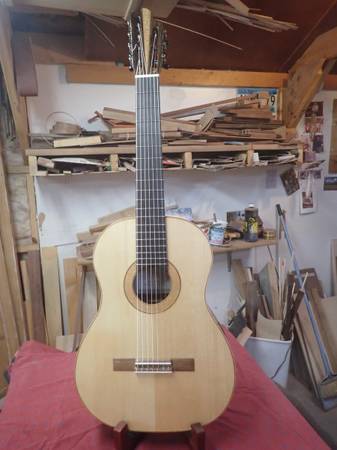
I am a novice guitar maker in Minneapolis, Minnesota. This is my 19th guitar, and the first seven string that I have made.
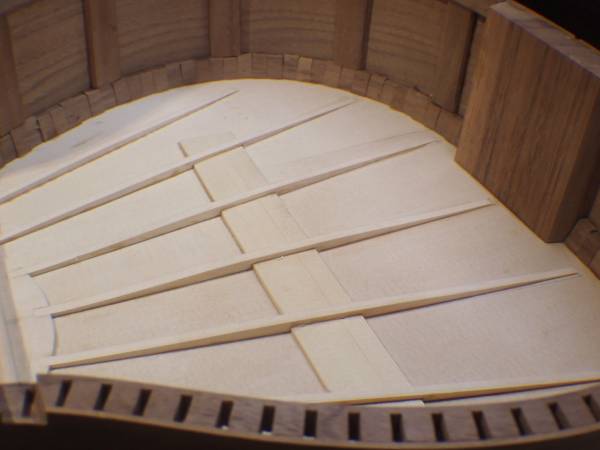
The soundboard of this guitar is a pair of “orphan” Sitka Spruce boards. Both halves are high quality, fine grained spruce, but they are not book matched The bracing is seven symmetric fan struts with open harmonic bars based on Jeffrey Elliott's design (American Lutherie 127, Fall 2016). The fan struts and other bracing are also made of Sitka spruce.
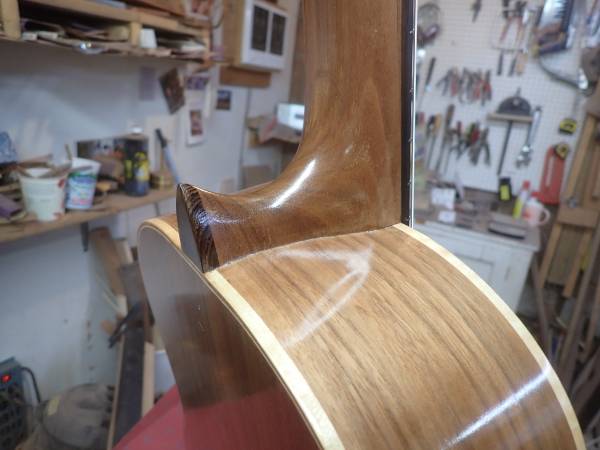
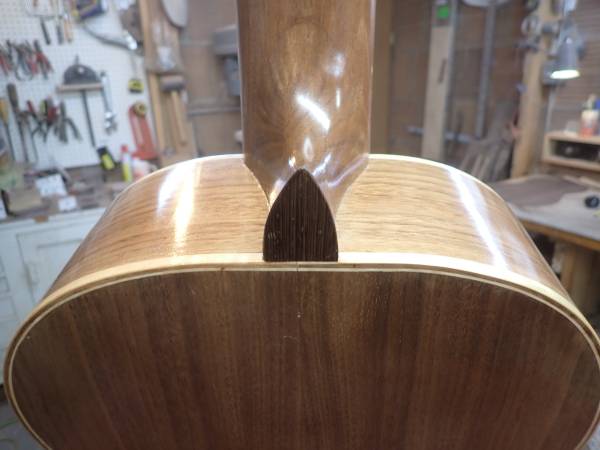
I like to incorporate reclaimed wood in my guitar builds. In this case I found an old dining room table put out for trash. It was probably mid to early 20th century, and it was made from black walnut. What a score! The sides and neck of this guitar are made from black walnut reclaimed from this discarded dining room table.
The fretboard of this guitar is made from a very nice piece of Macassar ebony. It is very even in color, more of a deep, chocolate brown than pure black.
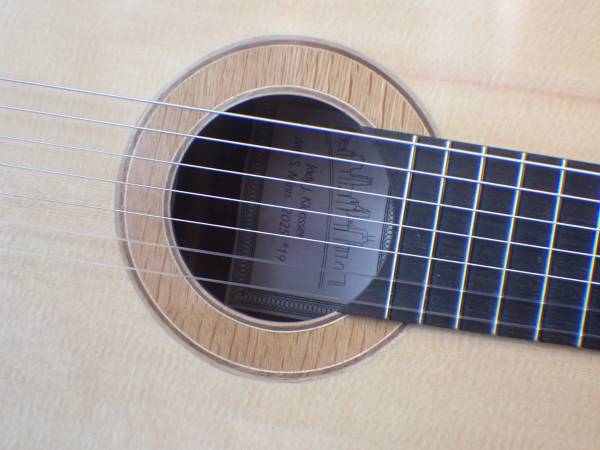
Keeping with a reclaimed wood theme, I made the central motif of the rosette for #19 from a piece of rift-sawn white oak. This particular piece of oak came from the table top of an old dining room table that belonged to my great grandparents. The central rift-sawn white oak motif is surrounded by bands of black walnut and maple.
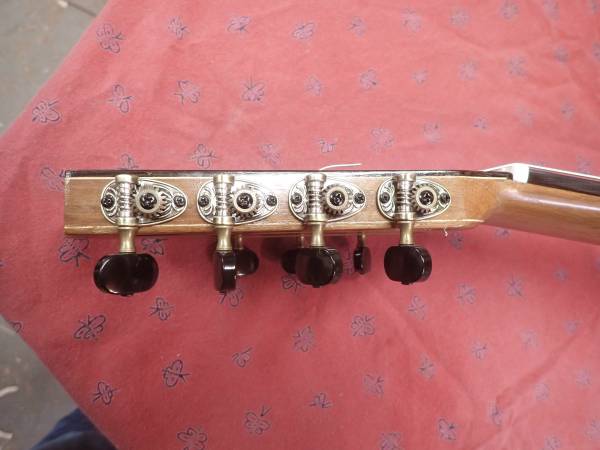
Continuing the white oak motif, the vee-shaped headstock and the lower bout end graft are of quarter-sawn white oak with a nice bit of medullary fleck. These pieces also came from my great grandparents’ table. The headstock has banding of cherry and Wenge to frame the string slots. The back of the headstock is a piece of quarter sawn black walnut.
The bridge is made of black walnut. It has an 21-hole tie bar made of bone. I like to use three tie bar holes per string. This gives multiple options to tie the strings.
#19 has a very even tone across the board. For this seven string, I used the same body size and bracing I use for my six string guitars. For Russian tuning, D2G2B2D3G3B3D4, this seems to work well. I have yet to try this guitar with standard six string tuning with a seventh low B.
#19’s neck is comfortable to play and very even feeling. It is “C” shaped. It has very little taper, and is about 22.5 mm from the nut to the 10th fret.
The action on #19 at the 12th fret is 3.8mm at the 7th string and just a bit under 3mm at the 1st string. The height at the bridge is 12.5 mm. When digging in, the 4th and 5th strings have some buzz with the current setup. I am happy to adjust the action to meet your playing style.
For the finish, I used a blonde shellac applied in the french polishing method. As a novice, I struggle with french polishing, and I am never quite happy with my results. On this guitar, I don’t quite see the evenness in sheen/gloss that I would like to have. It is an acceptable finish, but it does not match exacting standards.
Other issues: I have tried to keep the fretboard as narrow as possible while allowing for reasonable string spacing (8.1mm at the nut) and playability. I have given a little more room to the 1st string than the 7th string. This causes some issues with the 7th string slipping over the fret board edge. Again, I am happy to adjust the nut with a lower placement of the 7th string.
Figures:
Figure 1. Front view, body
Figure 2. Back view, body.
Figure 3. Front.
Figure 4. Back.
Figure 5. Close up of headstock.
Figure 6. Close up of back of headstock.
Figure 7 Tuning machines (der Jung 526)
Figure 8. Rosette and sound hole.
Figure 9. Black walnut bridge
Figure 10. 21 hole bone tiebar (3 holes per string).
Figure 11. Closeup of nut.
Figure 12. End graft motif.
Figure 13. Neck heel.
Figure 14. Neck heel.
Figure 15. Interior of sound board
Figure 16. Tone bars
Figure 17. Fan struts.
Figure 18. Acoustic response of guitar from tapping soundboard at main anti-node points.
Please send me a note with any questions or comments.